
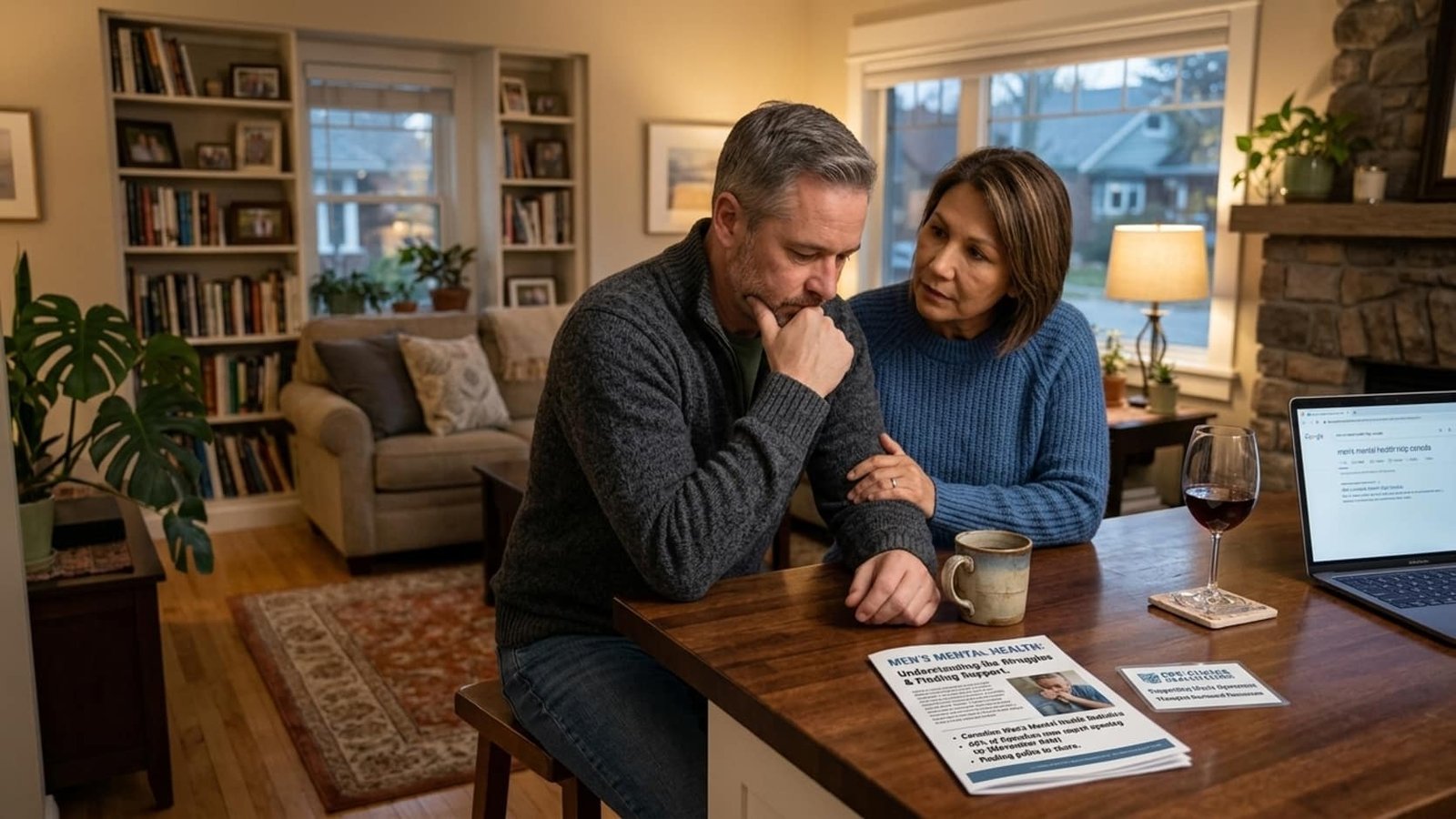
Why Is It So Hard for Men to Open Up About Mental Health?
Men find it hard to open up about mental health for three main reasons. Many learned early to handle problems alone. Their distress often shows up as anger, drinking or overwork instead of sadness. When they do speak up, the first response often goes badly. In a Movember survey, 45% of Canadian men regretted opening up. Many men still talk, though. They talk to partners, family doctors and search engines late at night.
Why Are Men Less Likely to Seek Mental Health Help?
Men are less likely to seek mental health help mostly because they prefer to cope alone. Statistics Canada published the clearest Canadian evidence in January 2026. Ellen Stephenson and Amélie Fournier analyzed the 2022 Mental Health and Access to Care Survey. Among people who needed counselling but went without, 44.6% of men preferred to handle it themselves. Among women, the figure was 35.4%.
Cost weighed less heavily on men. 20% of men cited affordability, compared with 36.3% of women. Young men faced a different problem. 40.7% of men aged 15 to 24 did not know where to get help. Among men aged 25 and older, the figure was 22.3%.
Men delay physical care too. Movember’s 2025 Canadian report surveyed 1,502 men. 65% waited more than six days with symptoms before seeing a doctor. 42% said a health practitioner had shown bias toward them as a man.
How Many Canadian Men Struggle With Their Mental Health?
About two in three Canadian men report moderate to high stress. About two in three have never used a professional mental health service. Both figures come from a 2025 Canadian Men’s Health Foundation survey of 2,000 men. The table collects the latest men’s mental health statistics for Canada.
Measure | Figure | Source |
Men meeting criteria for a mood or anxiety disorder, 2022 | 11.4% (women: 19.3%) | Statistics Canada |
Men with those disorders who consulted a health professional | 42.4% (women: 56.4%) | Statistics Canada |
Men with those disorders who received counselling or therapy | 40.2% (women: 50.1%) | Statistics Canada |
Men reporting moderate to high stress, 2025 | 64% | Canadian Men’s Health Foundation |
Men at risk of moderate to severe depression, 2025 | 23% | Canadian Men’s Health Foundation |
Men who have never used a professional mental health service | 67% | Canadian Men’s Health Foundation |
Men aged 18 to 54 comfortable discussing mental health with friends and family | 70% (physical health: 84%) | Movember and Ipsos, 2021 |
Men’s share of all suicide deaths in Canada | Nearly 75% | Health Infobase |
Men vs women suicide rates show the widest gap. Health Infobase reports the men’s suicide rate in Canada is almost 3 times the women’s rate. The highest rates appear among men aged 45 to 64. The “four times” figure on many websites comes from US data.
Alberta sits above the national average. CMHA’s 2024 profile puts Alberta’s suicide rate at 14.3 per 100,000, against 10.9 nationally. 29.3% of Albertans rate their mental health as fair or poor.
Why Do Men Hide Their Emotions?
Men hide their emotions mostly because of one learned rule. Handle it alone, and never let anyone see you struggle. That rule explains much of why men don’t talk about mental health. It also feeds the stigma of men’s mental health.
Movember and Ipsos MORI surveyed Canadian men in 2019. 59% felt expected to be “emotionally strong and not show weakness.” 37% avoided talking about feelings so they would not seem “unmanly.” Among men aged 18 to 34, 44% felt pressure to be manly. Only 16% of men over 55 said the same.
Do men suppress their emotions because of masculinity itself? The research points to specific habits instead. Wong and colleagues pooled 78 samples covering 19,453 participants in 2017. Self-reliance, playboy attitudes and power over women had the most consistent links to poor mental health. A strong focus on work showed no clear link.
Many articles blame “toxic masculinity.” A 2025 study by Eva Horton, Nathaniel Schermerhorn and Paul Hanel found a narrower cause. Restrictive emotionality, such as refusing to admit hurt feelings, predicted lower help-seeking. The broad label did not predict it directly. Men bottling up emotions is a learned habit, so it can change with practice.
Zac Seidler and colleagues reviewed 37 studies on masculinity and depression in 2016. Masculine norms changed how men’s symptoms showed up, whether men sought help and how they coped.
What Happens When Men Finally Open Up?
When men finally open up, the first response often decides whether they try again. In Movember’s Canadian survey, 45% of men regretted opening up about their problems. Nearly half of those men said the experience would stop them doing it again.
The same survey found strong belief in talking. 80% of Canadian men called talking an effective way to deal with problems. Men opening up reported more positive experiences (51%) than negative ones (31%). The reaction men meet decides what happens next.
Rob Whitley, a psychiatry researcher at McGill University, described those reactions in Psychology Today in 2022. He wrote about partners who questioned a man’s manhood after a disclosure. He also described friends who tuned out or reached for their phones.
Work adds risk. A Teladoc Health survey, cited by Whitley, asked workers about disclosure. About 1 in 4 feared it could cost them their job. About 1 in 3 expected to be passed over for promotion.
Sara Dorow and Valerie O’Leary studied 72 fly-in, fly-out oil sands workers in Alberta in 2021. Half of those with on-site health care said they were unlikely to use it. They cited confidentiality, reputation, layoffs and lost wages. One in seven men in that study reported thoughts of hurting themselves.
Why Are Men Less Likely to Be Diagnosed With Depression?
Men are less likely to be diagnosed with depression partly because standard checklists look for sadness. Many men show anger, heavier drinking or risk-taking instead. Lisa Martin, Harold Neighbors and Derek Griffith tested this in JAMA Psychiatry in 2013. With male-type symptoms alone, 26.3% of US men met criteria, against 21.9% of women.
Counting both symptom types together nearly closed the gap: 30.6% of men and 33.3% of women. The remaining difference was not statistically significant. Are men and women different emotionally, then? Depression in men vs women differs most in how it gets expressed.
What Are the Signs of Depression in Men?
The signs and symptoms of depression in males often include 6 overlooked changes:
- Irritability and a short fuse with family or coworkers
- Anger that seems out of proportion to the trigger
- Heavier drinking or other substance use
- Risk-taking, such as reckless driving or gambling
- Overwork that leaves no time to think or rest
- Physical complaints, including poor sleep, headaches and exhaustion
Male depression and anger often appear together in Canadian data too. The Canadian Men’s Health Foundation measured problem anger with a validated scale in 2025. 50% of men aged 19 to 29 were at risk of problem anger. The rate was 22% across all men and 36% among BIPOC men.
Many men never receive any diagnosis. A 2018 CDC report reviewed suicide deaths across 27 US states. 54% of those who died had no known mental health condition. Men made up 83.6% of that group.
Depression therapy treats irritability, drinking and poor sleep alongside low mood. Anxiety in men often looks like restlessness, tension or nonstop work. Anxiety therapy works on those physical and behavioural signs directly.
Where Do Men Talk When They Don't Talk to People?
Men often open up first to a partner, a family doctor or a search engine. Pew Research Center surveyed US adults in January 2025. 74% said they would lean on a spouse or partner for emotional support. Men and women answered alike. Men were far less likely to turn to a friend, at 38% against 54% of women.
Family doctors often see men before a crisis. Kim Stene-Larsen and Anne Reneflot reviewed 44 studies on care before suicide in 2019. 80% of people who died by suicide had seen primary care in the year before. 44% had done so in the final month. Only 31% had mental health care in the final year.
Phones carry the rest. HeadsUpGuys, a University of British Columbia resource for men’s depression, studied five years of traffic. 1,665,356 people visited, and 214,329 completed its depression self-check. 73% of sessions came from mobile phones. 57.9% of self-check users reported thoughts of being better off dead or of hurting themselves. Reading this page is already a way of reaching out.
If you are thinking about ending your life, help is available now. Call 911 or go to the nearest emergency department. Crisis lines across Canada answer 24 hours a day.
When Are Men Most at Risk of Struggling in Silence?
Men are most at risk of struggling in silence during separation, new fatherhood, midlife and isolation.
Michael Wilson’s team at Orygen reviewed 75 studies covering more than 106 million men. Psychological Bulletin published the review in 2025. Separated men under 34 had up to eight times the odds of suicide of married peers. Divorced men had 2.8 times the odds. Risk peaked right after a breakup.
New fathers face a risk that rarely gets discussed. James Paulson and Sharnail Bazemore pooled 43 studies covering 28,004 participants in JAMA in 2010. 10.4% of fathers experienced depression between pregnancy and their baby’s first birthday. The rate reached 25.6% at three to six months after birth.
Midlife brings the highest suicide rates. In 2019, men aged 45 to 64 accounted for 1,169 of Canada’s 4,012 suicides. The Centre for Suicide Prevention in Calgary reports that Statistics Canada figure. It also runs Buddy Up, a suicide prevention campaign by men, for men.
Isolation runs through all of these moments. The problem now has a popular name: the male loneliness epidemic. 50% of Canadian men were at risk of social isolation in 2025. The Canadian Men’s Health Foundation put the rate at 73% for men living alone.
How Do You Get a Man to Open Up About His Feelings?
You get a man to open up by making the first response safe, specific and calm. Here is how to get a man to open up about his feelings, in 7 steps:
- Pick a side-by-side moment, such as a drive or a walk.
- Ask a specific question, like “You’ve seemed wound up lately. How are you doing?”
- Use his words, such as stressed, wiped out or on edge.
- Listen before fixing, and hold advice until he finishes.
- Keep your reaction calm, even when his answer worries you.
- Follow up within a few days.
- Suggest one practical step, such as a doctor’s visit about sleep or stress.
A man who seems emotionally unavailable may be following years of practised self-reliance. Short conversations often feel easier for him than long talk. Men’s mental health therapy gives him a private place to keep talking, if he is ready.
Does a Man Need a Male Therapist to Open Up?
Most men do not need a male therapist, based on current research. Louise Liddon, Roger Kingerlee and John Barry surveyed 115 men and 232 women in 2018. Most had no preference for their therapist’s sex. Among men with a preference, female therapists were slightly more popular.
Men did rate support groups more highly than women did. In 2017, Canada had nearly three times as many women psychologists as men. At Canadian Psychological and Counselling Clinics, you can ask about clinician fit before booking.
What Does Therapy for Men Look Like at CPC Clinics?
Therapy for men starts with the problems you can already name. You do not need to know what is wrong before you book. Many men first describe stress, poor sleep or a short temper. Our psychologists and therapists start from those words.
Sessions focus on practical skills, such as spotting early warning signs and handling conflict at home. Our men’s mental health therapy runs in person at our Calgary clinic and online. Our psychological and counselling services also include assessments and care for depression and anxiety.
For many Canadians, November is men’s mental health month. Movember runs men’s mental health awareness campaigns throughout it. Men’s mental health support works in any month, though. CPC Clinics offers a first conversation with no obligation, if you are ready. That includes partners helping someone else take the first step.
[Start With a Conversation]
What Do People Ask Most About Men and Mental Health?
Why do men hide their feelings?
Men hide their feelings mainly because many learned that coping alone is what men do. In Movember’s 2019 survey, 59% of Canadian men felt expected to stay “emotionally strong.”
Why don’t men talk to their wives about their problems?
Many men do talk to their partners, often before anyone else. Silence at home often follows a disclosure that went badly, or fear of being a burden. In a Priory survey of 1,000 UK men, 36% stayed quiet to avoid burdening others.
Is it weak for a man to cry?
No. Crying is a normal human response to stress, loss and relief. It shows that something hurts. 80% of Canadian men say talking helps with problems, according to Movember.
Why do men shut down emotionally when they’re stressed?
Men often shut down under stress because emotional restriction is a learned coping habit. Horton and colleagues linked that habit to lower help-seeking in 2025. It protects in the moment but cuts off support over time.
Can depression in men show up as anger?
Yes. Anger, irritability and risk-taking are common signs of depression in men. In Martin’s 2013 study, counting these signs nearly closed the depression gap between men and women.
How do I know if my husband is depressed?
Watch for changes that last two weeks or more. Common signs include irritability, withdrawal, heavier drinking, poor sleep and constant work. A psychologist or family doctor can assess what is happening.
My partner won’t open up to me. What should I do?
Start with a calm, specific question at a low-pressure moment. Keep your first reaction calm, since 45% of Canadian men regret opening up. Listen without fixing, then follow up a few days later.
How can I help a man with depression who won’t get help?
Suggest one small step, such as a doctor’s visit about sleep or stress. 80% of people who died by suicide saw primary care in the prior year. Call 911 or a crisis line right away if he talks about ending his life.
Why is it hard for men to make friends?
Many male friendships depend on shared activities, and they fade when routines change. Half of Canadian men were at risk of social isolation in 2025. The Canadian Men’s Health Foundation reported that figure.
Why is men’s mental health often overlooked?
Men’s mental health gets overlooked because distress in men often looks like anger, drinking or overwork. In Movember’s 2025 report, 42% of Canadian men said a practitioner showed bias toward them.
Can men get postpartum depression?
Yes. About 1 in 10 fathers experience depression between pregnancy and their baby’s first birthday. Paulson and Bazemore’s 2010 review found 25.6% at three to six months after birth.
Why do men shut down after a breakup?
Men often shut down after a breakup because a partner was their main emotional support. A 2025 Psychological Bulletin review found separation raises men’s suicide risk, especially early on. Contact a crisis line or call 911 if he talks about ending his life.