
rTMS vs Deep TMS: Which Works Better?
No study has shown that deep TMS works better than rTMS. In trials, both beat sham treatment for depression that did not respond to medication. In a 228-patient trial, remission reached 60% with deep TMS and 43% with rTMS. Medication alone reached 11%. The gap between the coils fell within chance (P=.17).
So, does TMS work? Yes, for some people. Ontario Health found that rTMS produced about 23 more responders per 100 treated than sham. The rTMS vs dTMS evidence is thin. The main head-to-head trial followed patients for 4 weeks.
At Canadian Psychological and Counselling Clinics, we offer rTMS and have an interest in this topic. Every figure below comes from a named study or guideline. This guide gives general information, not medical advice. Our EXOMIND™ course differs from the trials below, and the sessions section says how.
What Is the Difference Between rTMS and Deep TMS?
rTMS uses a figure-8 coil that targets a focused area. Deep TMS uses an H-coil that reaches a broader, deeper field. Both send repeated magnetic pulses through the scalp to nerve cells in the prefrontal cortex. Researchers write dTMS for the H-coil version.
Clinics use TMS therapy and rTMS treatment for the same repeated-pulse approach. So rTMS vs TMS is a question of wording. “Deep” refers to field reach. It says nothing about how much mood improves. It has no link to deep brain stimulation, which needs brain surgery.
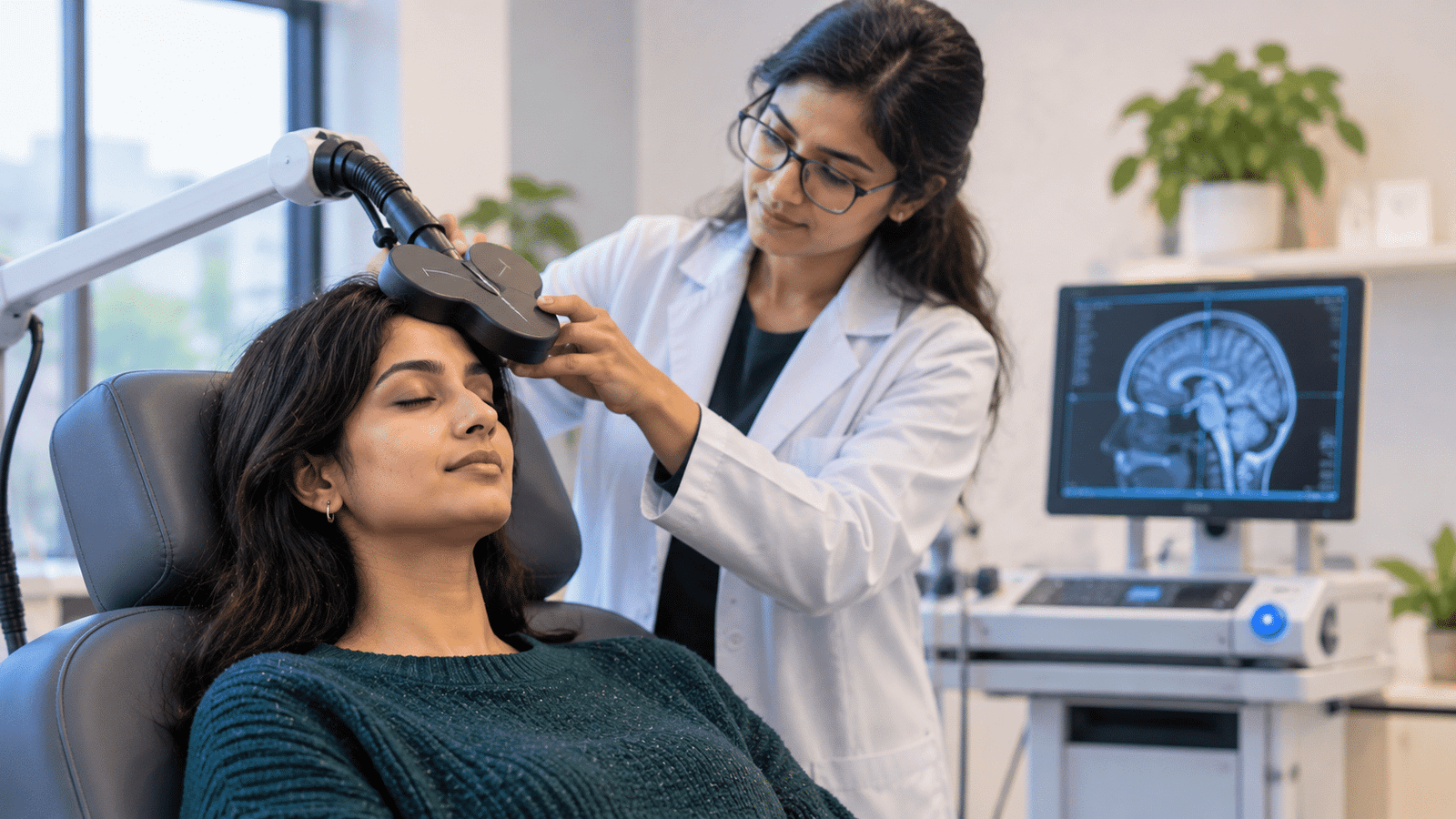
Transcranial magnetic stimulation (TMS) needs no surgery or sedation. In brain stimulation treatment with rTMS, a person sits in a chair. A coil rests on the scalp.
Does TMS Work, and What Is the TMS Success Rate?
Yes, in trials rTMS improved depression in some people. Ontario Health puts the gain at about 23 more responders per 100 treated. That 2021 Canadian health technology assessment compared high-frequency rTMS with sham in treatment-resistant depression. Sham treatment mimics a real session, so patients are less likely to know their group. CANMAT (2016) gives acute rTMS its highest evidence rating, Level 1.
Response means symptoms fall by half or more. Remission means symptoms fall to a minimal level. The same review found about 13 more remitters per 100 treated. That gives a number needed to treat of 4 for response and 8 for remission.
The TMS remission rate sits below the response rate because remission is a higher bar. Any TMS success rate also includes people who improve on sham.
Does Deep TMS Work, and What Is the Deep TMS Success Rate?
Yes, deep TMS beat sham in trials too. Levkovitz and colleagues ran the 2015 trial (World Psychiatry). At week 5, 38.4% of patients responded, against 21.4% on sham. Remission reached 32.6% with deep TMS and 14.6% with sham. The trial randomized 212 adults with major depression across several centres. Patients took deep TMS or sham without antidepressants.
Ontario Health pooled 3 deep TMS studies and rated the evidence high certainty (GRADE). It put the gain at about 21 more responders per 100 treated. It rated the rTMS response evidence moderate certainty. GRADE scores confidence in an estimate. It does not rank one coil above the other.
TMS for depression adds its effect on top of the placebo response, which reached 21.4% here.
What Does a Number Needed to Treat of 4 Mean?
A number needed to treat of 4 means 1 extra responder for every 4 patients. The extra responder is counted beyond sham. In the deep TMS trial, about 1 in 5 people responded to sham. The table shows the extra responders and remitters per 100 patients.
Source | Treatment | Extra responders per 100 | Extra remitters per 100 |
Ontario Health, 2021 | High-frequency rTMS | About 23 | About 13 |
Levkovitz, 2015 | Deep TMS | 17 | 18 |
The rows come from different trials, so they do not rank the coils. A number needed to treat of 8 means 1 extra remission for every 8 patients. Both figures describe averages across patients, not a result for any one person. Some people respond to sham, so not every responder owes the response to the coil.
Is Deep TMS Better Than rTMS?
No, the evidence does not show deep TMS beating rTMS. Paganin and Contini (2025, Journal of Neural Transmission) reviewed the field. They found 3 comparative studies in treatment-resistant depression: 1 observational and 2 randomized. The review found no significant difference in remission.
Filipčić and colleagues ran the main trial (2019, Journal of Psychiatric Research). It randomized 228 patients to deep TMS, rTMS or medication alone. It defined remission as a score of 7 or lower on the 17-item Hamilton depression scale. Remission reached 60% with deep TMS and 43% with rTMS. Between the coils, the adjusted odds ratio was 1.74 (95% CI 0.79 to 3.83, P=.17).
Only the raters were blinded to group. The medication-only group got no sham, so the trial cannot measure placebo response.
Two things limit that result. First, the protocols differed. Frequency was 10 Hz vs 18 Hz. Pulses per session were 3,000 vs 1,980. Session length was 40 vs 20 minutes. The trial compared 2 protocols, and the coil was one of several differences.
Second, the confidence interval is wide. It runs from a slight rTMS edge to a nearly fourfold deep TMS edge in odds. A 17-point remission gap would matter if real, and the trial could not confirm it. A trial that gave both coils the same dose would isolate the coil. Dropout ran 9.7% with deep TMS, 4% with rTMS and 11.1% with medication alone.
Ontario Health reached a matching conclusion in 2021. All TMS modalities were similar to each other and to ECT for response and remission.
Why Do Some TMS Success Rates Look Higher Than Trial Results?
Clinic counts run higher because they lack a sham group and can omit dropouts. In the deep TMS trial, 21.4% of people responded to sham. That placebo response sits inside the trial’s 38.4% treatment figure. A clinic record cannot separate the two. A count that omits dropouts also overstates the result for everyone who started.
Four checks make any quoted TMS success rate easier to read:
- Does the figure come from a trial with a sham group?
- Does it count response or remission?
- Does it include people who stopped before the course ended?
- Who collected and paid for the data?
How Many TMS Sessions Do You Need, and What Is Theta Burst Stimulation?
CANMAT (2016) describes a TMS course as 20 to 30 sessions over 4 to 6 weeks. Filipčić’s trial gave 20 sessions over 4 weeks, 5 a week.
CPC Clinics offers EXOMIND™, an rTMS system. A typical course at CPC Clinics runs about 6 sessions over 3 weeks. The trials in this guide tested other devices. Their results do not describe EXOMIND™ or a 6-session course. One published EXOMIND™ study gave 4 sessions to 33 adults and had no control group.
Results take time to appear. Filipčić’s trial counted results at week 4 and the deep TMS trial at week 5. Ontario Health pooled outcomes at the end of treatment, 2 to 6 weeks across trials. A patient 12 sessions in sits mid-course, before those trials counted results. Individual timing varies, and trial data cannot predict it.
Theta burst stimulation shortens each session to 3 minutes. Blumberger and colleagues at CAMH led the THREE-D trial (Lancet, 2018). It randomized 414 patients across 3 Canadian sites. Intermittent theta burst was non-inferior to standard 10 Hz rTMS. That means it fell short by no more than a preset margin, if at all.
Standard sessions ran 37.5 minutes, against 3 minutes for theta burst. Deep TMS sessions in Filipčić’s trial lasted about 20 minutes. Session length alone no longer separates the coils.
How Long Does TMS Last, and What Is the TMS Relapse Rate?
TMS benefit fades in some people. CANMAT (2016) cites a study of relapse in people who received no maintenance treatment. Relapse reached 25% at 2 months and 40% at 3 months. It reached 57% at 4 months and 77% at 6 months. Median time to relapse was 120 days.
CANMAT rates maintenance TMS evidence at Level 3. Acute treatment earns Level 1.
Dunner, Janicak and colleagues (2014, Journal of Clinical Psychiatry) followed patients for a year. The study was naturalistic, with no control group. Of 120 people who responded or remitted, 75 (62.5%) kept their response at 12 months. Some patients had TMS reintroduced during follow-up. The designs differ, so the figures do not compare directly.
Filipčić’s trial ended after the 4-week course. It cannot show which coil lasts longer.
Is TMS Safe, and Does TMS Hurt?
TMS carries a seizure risk of about 0.01% to 0.1%, according to CANMAT (2016). CANMAT puts seizure risk on antidepressants at 0.1% to 0.6%. In the general population, it is 0.07% to 0.09%.
The most common TMS side effects are scalp discomfort (about 40%) and headache (about 30%). CANMAT describes both as transient. Sensation varies from person to person. Clinics can adjust intensity when a patient reports pain.
Deep TMS side effects in Filipčić’s trial included headache in 29% of patients. Headache affected 20% of rTMS patients. Muscle twitching or jaw pain affected 12% of the deep TMS group. No serious adverse events occurred in that trial. These small differences come from one trial. They do not show that either coil is safer.
Who Is a Candidate for TMS?
CANMAT (2016) names adults who did not improve on at least 1 antidepressant for first-line rTMS. The trials above enrolled adults with major depression, and Ontario Health reviewed treatment-resistant cases. A physician or psychiatrist decides whether TMS suits a person.
That placement means care often starts with medication or therapy. Our guide on medication or therapy first for depression covers that first step.
A clinician screens before the first session. CANMAT lists absolute contraindications for high-frequency rTMS. They include a history of seizures and metal in the head, apart from the mouth.
Does TMS Work for OCD or Anxiety?
The trials above do not show whether TMS works for OCD or anxiety. TMS for OCD and TMS for anxiety each have their own trials and protocols. Regulators also license each device for named conditions, and the list differs by device.
Health Canada’s Medical Devices Active Licence Listing (MDALL) shows what a licensed device covers. Any OCD or anxiety claim needs a named trial behind it.
Anxiety therapy follows a different path. It uses CBT and ACT with a registered therapist.
Is TMS Better Than ECT?
Ontario Health (2021) found all TMS modalities similar to ECT for response and remission. That includes the rTMS vs ECT comparison. The treatments differ in delivery. TMS treatment runs while the patient is awake. ECT induces a seizure under a general anesthetic.
Similar average results do not mean the two suit the same person. A psychiatrist weighs symptom severity and treatment history to choose between TMS vs ECT.
How Do You Choose a TMS Clinic?
Ask 5 questions about device, protocol, supervision, relapse planning and full course cost. No study ranks the coils. So the coil name tells you less than the protocol and the follow-up plan.
- Which device does the clinic use, and which conditions has Health Canada licensed it for?
- Which protocol applies, including frequency, pulses per session and sessions per course?
- Who screens patients, supervises sessions and reviews progress?
- What is the plan if benefit fades?
- What does the full course cost, including extra sessions?
The evidence in this guide covers figure-8 and H-coil devices at the protocols studied. Three protocols appear above. 10 Hz rTMS delivered 3,000 pulses a session. 18 Hz deep TMS delivered 1,980. Intermittent theta burst ran 3 minutes a session. A different protocol carries its own evidence base.
How Can CPC Clinics Help?
CPC Clinics offers rTMS alongside counselling and psychological assessments. Psychologists and counselling services sit under one roof. You can discuss treatment options in one place.
The 5 questions above apply to us too. Whether TMS suits you is a medical decision for you and your physician or psychiatrist.
Start With a Conversation about rTMS.
What Else Do People Ask About TMS?
How Much Does TMS Cost, and Is TMS Covered by Insurance in Canada?
Cost and coverage depend on the program. Public programs set their own referral rules. Private clinics bill patients directly, and extended health plans set their own terms, so TMS covered by insurance varies by plan. The rTMS cost in Canada differs by clinic, so this guide quotes no prices. Ask for the full course cost in writing.
Is Deep TMS Approved in Canada?
Health Canada licenses each device for stated uses, and the list differs by device. A licence permits marketing for those uses. It does not rate how well a device works, and a licence for depression does not extend to other conditions. TMS treatment in Canada runs on licensed devices, and transcranial magnetic stimulation in Canada follows that same rule. Search the device on MDALL to see its licensed uses.
Do You Need 36 Sessions, and Are One-Day Versions as Good?
Course length depends on the protocol. Filipčić’s trial used 20 sessions over 4 weeks, and CANMAT describes 20 to 30 sessions. A typical course at CPC Clinics runs about 6 sessions over 3 weeks, a separate protocol with its own evidence base. Accelerated schedules pack sessions into fewer days. Ask any clinic which published evidence supports its schedule. If a clinic adds sessions mid-course, ask what the extra sessions target.
Can TMS Make Anxiety Worse?
The trials in this guide measured depression scores, so they say little about anxiety after treatment. A treating clinician reviews rising anxiety and can adjust the plan. New or worsening symptoms can be raised at any visit.
Why Do I Feel Worse After TMS?
Headache and scalp discomfort are common effects after a session, and mood can shift during any depression treatment. A treating clinician reviews a drop in mood, whether it appears the same day or weeks after a course. Benefit can fade in some people. Get help now if you are thinking about ending your life. Call 911 or your local emergency number. You can also contact a crisis line in your area.
Are There Long-Term Side Effects of TMS?
CANMAT (2016) names seizure as the main serious risk, at about 0.01% to 0.1%. CANMAT describes headache and scalp discomfort as transient. Filipčić’s trial followed patients for 4 weeks, so it cannot show long-term differences between coils. The sources here do not cover ringing in the ears or memory changes. A clinician can discuss any symptom that lasts after a course.
What Is the Controversy With TMS, and Is It a Scam?
TMS has sham-controlled evidence behind it, but individual clinic claims need checking. The debate centres on 3 points: how much rTMS adds beyond sham (a number needed to treat of 4 for response and 8 for remission), how long benefit lasts, and whether clinic claims match trial data. Ask any clinic to name the study behind each number it quotes.