
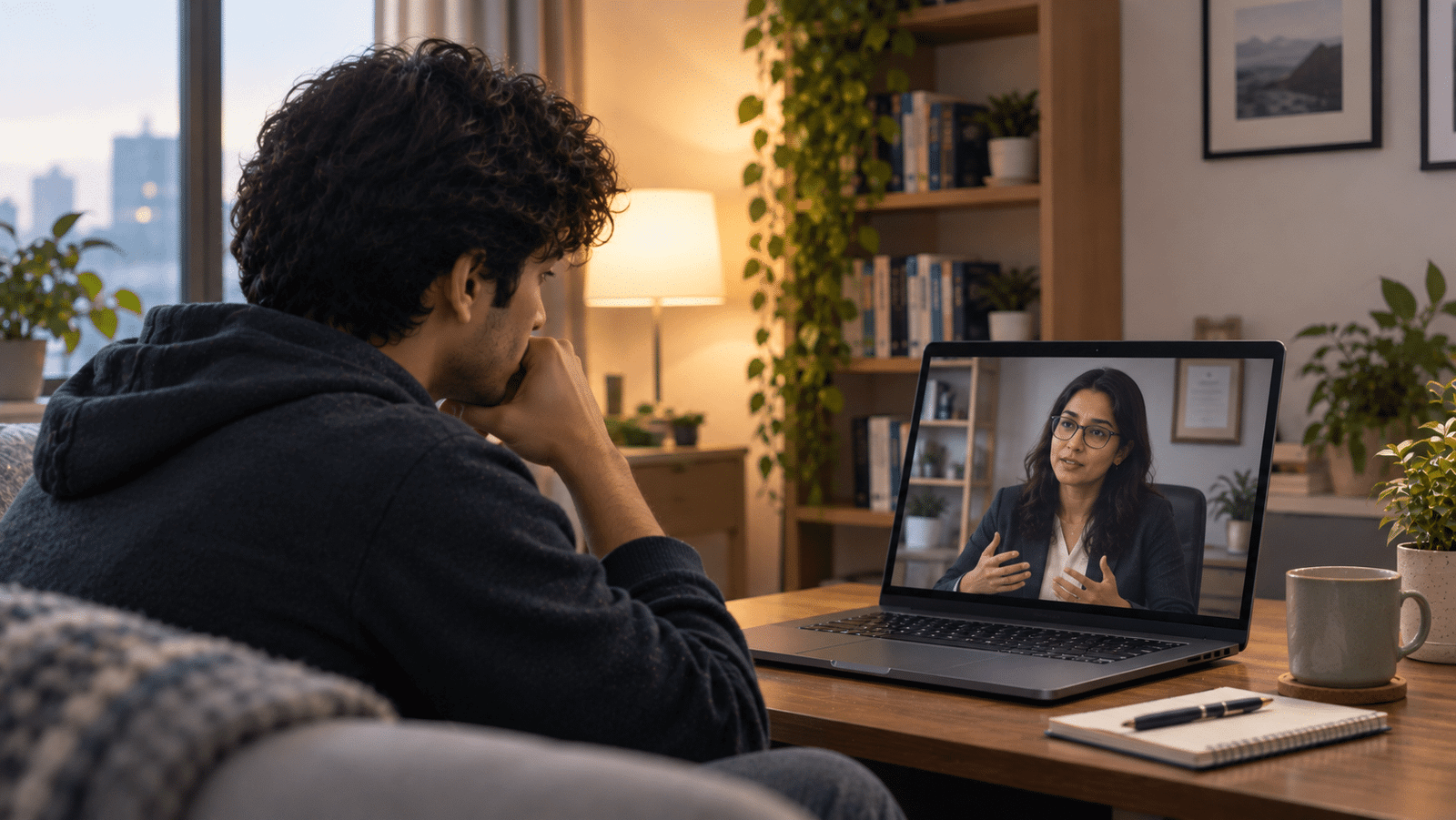
Can Virtual Therapy Work for Anxiety and Depression?
Reviewed by Zarrin Tasneem, Registered Provisional Psychologist and Clinical Director, CPC Clinics. Last reviewed November 2026.
Yes, virtual therapy can work for anxiety and depression for most adults. A 2023 review pooled 17 randomized trials and 1,814 people. Live video therapy and in-person therapy produced the same symptom change. A 2024 Canadian review of 51 remote CBT trials found the same result.
So, is online therapy effective? For many people, yes. Does online therapy work for everyone? No. Your symptoms and your home setting still affect the answer.
This guide covers virtual therapy for anxiety and depression. It sets out what the research shows and where it is thin. It also covers who might do better in person.
At Canadian Psychological and Counselling Clinics, we offer virtual and in-person sessions. Every figure below comes from a named study, survey or guideline. This guide gives general information, not medical advice.
What Counts as Virtual Therapy?
Virtual therapy covers two different things: live sessions and self-paced online programs. Research on one does not prove the other. Many articles blend the two, which makes the evidence sound stronger than it is.
Live virtual therapy is a real-time session with a psychologist or therapist, by video or phone. Psychologists call this telepsychology.
Online programs work differently. They deliver internet-delivered CBT (iCBT) as weekly lessons. Some add short written check-ins from a therapist. Self-guided apps sit at the far end, with no therapist involved. If you are comparing services, ask which kind each one offers.
Format | What happens | What the research shows |
Live video sessions | Real-time therapy with a psychologist on a secure platform | Same results as in-person therapy, moderate certainty (Shaker, 2023) |
Phone sessions | Real-time therapy by phone | Fewer trials. One large depression trial found lower dropout than in-person care (Mohr, 2012) |
Guided online therapy | Self-paced iCBT lessons plus therapist feedback | Similar results to face-to-face CBT across 31 trials (Hedman-Lagerlöf, 2023) |
Self-guided apps | Exercises with no therapist | Small effects across 176 trials (Linardon, 2024) |
Is Online Therapy as Effective as In-Person Therapy?
Yes, for most adults with anxiety or depression, research finds no meaningful difference. Four large reviews point the same way:
- Shaker and colleagues (2023): 17 trials, 1,814 people, video vs in-person. Difference: −0.01.
- Zandieh and colleagues (2024, CMAJ): 51 trials, 5,384 patients, remote vs in-person CBT. Difference: −0.02.
- Fernandez and colleagues (2021): 36 comparisons of video vs in-person therapy. Difference: 0.01.
- Hagi and colleagues (2023): 32 trials, 3,592 people, 11 conditions. No overall difference.
These numbers are effect sizes. A score near zero means both formats helped people by about the same amount. Across the virtual therapy vs in-person therapy research, that pattern holds for most adults.
“No difference found” does not mean “identical.” Shaker and Zandieh both rated their certainty as moderate. A 2026 review, mostly of PTSD trials, rated it low. Few trials formally tested whether video stays within a set margin of in-person care.
So, is teletherapy effective? The fairest answer is “about as effective as in-person care,” on moderate-certainty evidence.
Does Virtual Therapy Work for Depression?
Yes, virtual therapy for depression produces results close to in-person care in trials. Shaker’s review included 5 depression trials with 438 people. Video and in-person therapy showed no reliable difference. Zandieh found the same across 14 depression trials.
A US trial tested home video therapy in 241 veterans aged 58 or older. They received 8 sessions of behavioural activation. Video care held up against same-room care on 2 depression scales (Egede, 2015, Lancet Psychiatry).
Online therapy for depression through structured programs also helps. Karyotaki and colleagues pooled patient data from 39 trials and 9,751 people (2021, JAMA Psychiatry). With therapist guidance, 48% cut their symptoms by half or more. Without guidance, 37% did.
Our page on depression therapy in Calgary explains how sessions run in person and by video.
Does Virtual Therapy Work for Anxiety?
Yes, virtual therapy for anxiety helps, though few trials test live video for anxiety alone. Online CBT for anxiety has the deepest evidence base. Pauley and colleagues reviewed 47 trials and 4,958 participants (2023, Psychological Medicine). Digital CBT programs produced a large effect against control groups (g = 0.80). Most control groups in this research were waiting lists, which makes effects look larger.
Results differed by condition:
- Panic disorder: g = 1.08
- Social anxiety disorder: g = 0.76
- Generalized anxiety disorder: g = 0.62
Online therapy for anxiety through live video has less research behind it. A 2021 review found only 5 small trials comparing telehealth with in-person care. Outcomes were comparable through 12 months (Krzyżaniak, 2021).
One Canadian study points slightly the other way. At a Hamilton anxiety clinic, 413 adults took 12-week group CBT. Some groups met in person and some by video. In-person groups showed a slight edge, significant only for generalized anxiety disorder (Milosevic, 2022). The study was not randomized.
Virtual CBT therapy for anxiety uses the same tools as office sessions. Those tools include thought records, exposure plans and practice between sessions. Our anxiety therapy in Calgary page describes the approaches we use.
Does Virtual Therapy Work for OCD and Panic Attacks?
Yes for OCD, with growing evidence; panic disorder has less research by video. OCD treatment relies on exposure and response prevention (ERP). In ERP, people face triggers without doing their compulsions. Video lets a therapist coach this work at home, where many triggers happen.
A 2025 study followed 2,173 young people who had ERP by live video. Their OCD symptoms fell by a median of 38%. About half responded fully, and gains held at about one year (Feusner, 2025). Severe cases did about as well as mild ones. The study had no comparison group.
For panic disorder, the evidence is thinner and older. One small trial had 21 people with panic disorder and agoraphobia (Bouchard, 2004). Video CBT did as well as in-person CBT. Online programs show large effects for panic (Pauley, 2023). Even so, NICE keeps online panic programs in research use only.
A 24-week Japanese trial of 199 adults covered depression, anxiety disorders and OCD. Video care held up against in-person care on quality of life (Kishimoto, 2023).
Are Mental Health Apps the Same as Online Therapy?
No, apps and guided online therapy produce different results. On the mental health apps vs therapy question, the gap is clear.
Linardon and colleagues reviewed 176 app trials (2024, World Psychiatry). Apps had small effects: g = 0.28 for depression and 0.26 for generalized anxiety. Real-world use drops fast. Across 93 Android mental health apps, 3.3% of users still opened the app at day 30. That figure is a median (Baumel, 2019).
Guided online therapy keeps people engaged far better. In Karyotaki’s data, 76% of people in guided programs kept up with the work. In self-guided programs, 54% did. The guided advantage grew with severity. At moderately severe symptoms, 55% responded with guidance and 40% without.
Apps can support skills practice between sessions. The research does not support them as a replacement for therapy with a professional.
Do the Benefits of Online Therapy Last?
Yes, for many people, though the advantage over usual care shrinks over time. In Karyotaki’s data, online CBT still beat usual care at 6 months. By 12 months, the gap was small and no longer clear.
The EVIDENT trial followed 1,013 adults with mild to moderate depression. They used an online program or usual care. The effect was d = 0.40 at 3 months and 0.27 at 12 months (Kaiser, 2021). After 18 months, the difference faded. By then, the usual-care group could use the program too.
Live sessions show a similar pattern. In Mohr’s trial of 325 patients, phone CBT matched in-person CBT at the end of treatment. At 6 months, the in-person group held its gains better.
In any format, ask your therapist how you will keep your progress after sessions end.
What Does Canadian Data Show About Online Therapy?
Canadian data show high need, wide use and high satisfaction with online therapy in Canada. Statistics Canada surveyed 9,861 people in 2022. The survey covered mood, anxiety and substance use disorders. Among Canadians aged 15 and older, 18.3% met criteria for one. That figure covers the past 12 months. Generalized anxiety disorder doubled from 2.6% in 2012 to 5.2%. Major depressive episodes rose from 4.7% to 7.6%.
The biggest gap is counselling, not medication. Among people with a disorder, 30.5% had unmet or partly met counselling needs. Only 7.0% said the same about medication.
Virtual care already fills part of that gap:
- 45.1%: share of people seeing a psychologist who had video contact (Statistics Canada, 2022).
- 82%: Canadian virtual mental health users who were satisfied. The 10-country average was 74% (CIHI, 2024).
- 45%: recent mental health service users who used virtual support (MHCC poll, 2026).
Canadian outcome data exist too. The University of Regina’s Online Therapy Unit offers guided online CBT. It has served more than 14,000 clients. Wellbeing Course clients report a 51% to 56% average drop in depression and anxiety symptoms. In one routine-care sample, about 40% showed no reliable improvement (Sapkota, 2024).
Can You Build a Real Connection With a Therapist Over Video?
Yes, most studies find the working relationship holds up over video. Researchers call this relationship the therapeutic alliance. It predicts how well therapy goes.
In Shaker’s review, patients rated the alliance about the same over video and in person. That finding covers 6 trials and 539 people. An earlier review of 12 studies could not rule out a small dip in alliance scores. That review was Norwood (2018). Symptom outcomes in that review still matched in-person care.
People stay in video therapy about as often as office therapy. Dropout did not differ across 20 trials and 2,804 people (Shaker, 2023). Hagi’s review found the same across 27 trials and 3,341 people. In Mohr’s trial, 20.9% dropped out of phone CBT. For in-person CBT, the figure was 32.7%.
What Are the Pros and Cons of Online Therapy?
Online therapy removes the commute but asks more of your home setup. This table sets out the main online therapy pros and cons.
Pros | Cons |
No commute, parking or time off for travel | Needs a private room and a stable internet connection (CPA guidelines) |
Symptom results match in-person care in most trials | People less comfortable with technology may benefit less (NICE, 2023) |
Dropout no higher than in-person care across 20 trials | Fewer body-language cues for the therapist |
A phone option lowered dropout in one large depression trial | Crisis support is harder at a distance |
Skills practice happens at home, where many problems occur | 42% of Canadians prefer all in-person care, and 29% prefer a mix (MHCC, 2026) |
The disadvantages of online therapy are mostly practical. A shared apartment, a weak connection or a busy household can get in the way. Tell your clinic about these early. Phone sessions are one workaround.
How Do Psychologists Keep Virtual Sessions Safe?
Psychologists set up a safety plan before the first video session. Two sets of standards describe the steps. One is the Canadian Psychological Association’s telepsychology guidelines. The other is the 2022 best practices from the American Psychiatric Association and American Telemedicine Association.
- Location: the psychologist records where you are during sessions.
- Contacts: you share a phone number and name a support person.
- Local resources: the psychologist learns the crisis services near you.
- Backup plan: you agree on a second way to connect if the video drops.
- Privacy: you choose a private space, with an optional code word if someone walks in.
- Fit check: the psychologist reviews risk history and steps up care if needed.
Neither guideline bans video therapy for people at risk. They set conditions instead. The CPA guidelines note that some conditions suit in-person care better.
Who Might Do Better With In-Person Therapy?
People with high risk, severe symptoms or no private space often do better in person. A hybrid plan also works for many. NICE advises more therapist contact first for more severe depression. It gives the same advice for people with suicidal thoughts.
In-person or hybrid care also fits people who:
- Lack privacy: no room where others cannot overhear.
- Struggle with technology: dropped calls or confusing platforms add stress.
- Need real-world exposure: some anxiety work happens in feared places, outside the home.
- Prefer it: in the 2026 MHCC poll, 53% of in-person-only users gave a clear reason. They preferred in-person support or felt their needs were too complex for online care.
How Can CPC Clinics Help?
At CPC Clinics, we offer virtual therapy in Calgary by secure video and by phone. We also see clients in person. We provide online therapy across Alberta. Sessions in other provinces depend on each clinician’s registration there.
Our team includes registered provisional psychologists and a clinical social worker. With an online psychologist at CPC Clinics, you get the same evidence-based approaches as in person. That includes CBT. You can start online, move in person, or mix both. Learn more about our psychologists and counselling services.
Whether virtual therapy suits you depends on your symptoms, your setting and your preferences. A short conversation with our team can help you decide.
Get help now if you are thinking about ending your life. Call 911 or your local emergency number. You can also contact a crisis line in your area.
What Else Do People Ask About Virtual Therapy?
Does Online Therapy Work for Severe Depression?
Yes, but it works best with more therapist involvement. In Karyotaki’s data, guidance made the biggest difference at moderate to severe symptoms. An earlier review covered 2,470 patients (Bower, 2013, BMJ). People with more severe depression benefited at least as much from lower-intensity care. NICE still advises more therapist contact first for severe depression. Online therapy for severe depression suits live sessions more than self-guided apps.
Is Phone Therapy as Good as Video Therapy?
Yes, for many people, though phone has fewer trials than video. On phone therapy vs video therapy, a 2022 review found both reduce mood symptoms (Chen, 2022). Mohr’s phone trial found lower dropout than in-person care, but weaker gains at 6 months. Phone is common in Canada. In 2022, 51.4% of people with a disorder who saw a professional did so by phone.
Does Text Therapy Work for Depression?
Yes, early trials show text therapy for depression can match video sessions. A 2024 trial of 215 adults found similar improvement with messaging and video (Areán, 2024). Messaging clients stayed in therapy longer: 7.8 weeks against 4.9. A 2025 trial of about 850 adults found comparable results (Pullmann, 2025). Both trials ran on one commercial platform, so results may not apply to every service.
Do I Have to Keep My Camera On?
No, not always. Video lets your therapist read facial expressions, so many therapists prefer it. If the camera makes you anxious, ask about phone sessions or a gradual start. You can also hide your own image on screen. Many people find that less distracting. Tell your therapist early. Camera discomfort is common, and therapy can address it.
Is Online Therapy Good for Social Anxiety, or Does It Let Me Avoid My Fears?
Yes, it can help, and avoidance is a fair concern. Online therapy for social anxiety has evidence behind it. Digital CBT produced a g of 0.76 for social anxiety disorder (Pauley, 2023). NICE recommends a therapist-supported online program for social anxiety disorder. Exposure eventually means practising in real social settings. A therapist plans that step with you, online or in person.
How Long Does Online Therapy Take to Work?
Most structured programs in the research run 8 to 18 weekly sessions. The Online Therapy Unit’s Wellbeing Course runs 8 weeks. The Mohr trial gave 18 sessions of phone or in-person CBT. How long does online therapy take to work for you? That depends on severity, practice between sessions and fit with your therapist. Ask your therapist to track your symptoms with a short questionnaire.
What If Online Therapy Feels Awkward or I Can’t Open Up?
Many people feel awkward in early sessions, online or in person. Say it out loud in the session. Your therapist can slow the pace or change the format. Turn off self-view and use headphones. Pick a spot where no one can overhear. Most studies find the working alliance over video matches in-person care.
What Should I Expect in My First Virtual Therapy Session?
Expect paperwork, a safety check and a conversation about your goals. Knowing what to expect in a virtual therapy session helps. Your psychologist confirms your location, contact details and a support person. You review consent and privacy. Then you talk through what brought you in and agree on a plan. Join a few minutes early to test your audio and video.
Is Virtual Therapy Safe If I’m Having Thoughts of Suicide?
Yes, it can be, with safeguards. It is not emergency care. Guidelines ask psychologists to assess risk before video sessions begin. They also set an emergency plan with you. NICE links suicidal thoughts with a need for more therapist involvement. If you are in danger now, call 911 or your local emergency number. You can also contact a crisis line in your area.
Can I Switch Between Online and In-Person Sessions?
Yes, many clinics offer hybrid care. In the 2026 MHCC poll, 29% of Canadians preferred a mix of in-person and virtual care. The 2022 APA and ATA best practices describe hybrid options as part of good care. Some people start in person and move online. Others do the reverse. Ask your clinic which sessions suit each format.
Can I See My Therapist Online While Travelling to Another Province?
Sometimes, depending on the province. Since April 1, 2024, an interprovincial agreement covers most of Canada, including Alberta. A psychologist must be registered where the client is located during the session. A limited telepsychology certificate also counts. Quebec, Nova Scotia and New Brunswick use a different rule. Tell your psychologist before you travel.
What Should I Do If Virtual Therapy Isn’t Helping?
Raise it with your therapist first. Online therapy does not work for everyone. In one Canadian routine-care sample, about 40% showed no reliable improvement after an online CBT course. Options include more sessions, a different approach or in-person care. A medical review with your doctor is another option. Stepped care moves you to more support when progress stalls.