
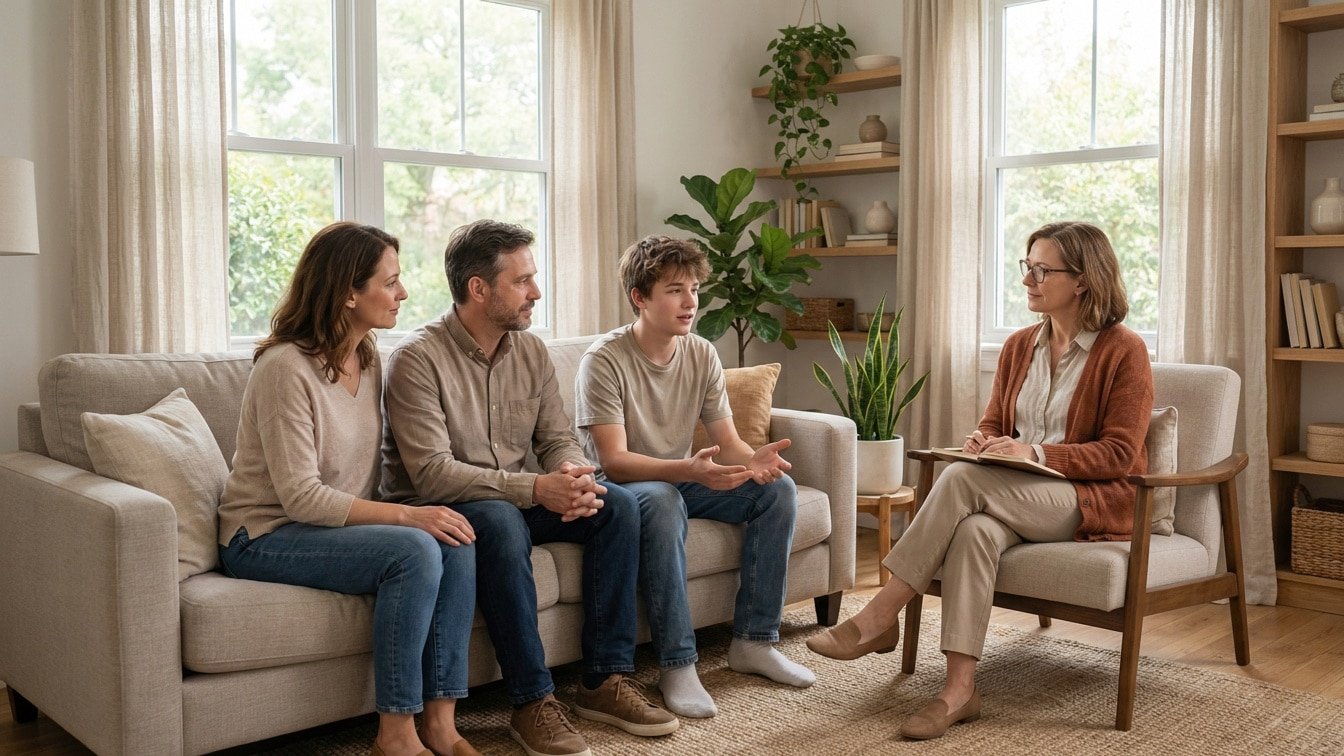
How Can Family Counseling Improve Communication?
Reviewed by Zarrin Tasneem, Registered Provisional Psychologist and Clinical Director, and Marggie Marks, Registered Clinical Social Worker, CPC Clinics. Last reviewed November 2026.
Family counselling improves communication by slowing arguments down and coaching new ways to talk. A therapist helps each person see the pattern the family keeps repeating. Then everyone practises a different response in the session until it works at home.
The research supports this. A 2003 review pooled 20 meta-analyses of marriage and family therapy (Shadish and Baldwin). Across 12 of them, treated families beat untreated families by a medium margin.
So how can family counseling improve communication in your home? This guide covers the patterns therapists target and the techniques they use. It also covers Canadian data and when joint sessions are not the right first step.
At Canadian Psychological and Counselling Clinics, our therapists work with parents, teens and adult families. This guide gives general information, not medical or legal advice.
How Does Family Therapy Improve Communication?
Family therapy improves communication in 5 ways. It slows conflict down, shows the pattern, balances airtime, swaps blame for requests and teaches repair.
- Slower conflict: The therapist sets ground rules, so one person speaks at a time. Heated moments get paused before they escalate.
- A visible pattern: Families learn to see a loop instead of a villain. One person’s criticism and another’s silence feed each other.
- Balanced airtime: Quieter members, often teens, get time to speak without interruption.
- Requests instead of blame: "You never help" becomes "Can you clear the table on school nights?"
- Repair: Families practise how to come back to a conversation after it goes wrong.
In practice, it is family conflict resolution with a therapist coaching in the room. Family counselling for communication problems does not need every member present from day one. A change in one person’s response can shift the whole loop.
Does Family Therapy Work?
Yes, family therapy works for many families, with medium-sized benefits over no treatment. It also performs about as well as other established therapies. Four large reviews show the pattern:
- Shadish and Baldwin (2003): 20 meta-analyses. Across 12, the effect was d = 0.65 after therapy and 0.52 at follow-up. Between 40% and 50% of people treated showed clinically meaningful change.
- Riedinger and colleagues (2017): 56 randomized trials of systemic therapy for children and teens. The effect was g = 0.59 against no treatment and g = 0.32 against other treatments.
- Pinquart and colleagues: 37 randomized trials in adults with mental health conditions. The effect was g = 0.51 against no treatment, with lower dropout than other treatments.
- Cochrane (Henken, 2007): 6 studies of family therapy for depression. Three studies gave moderate evidence that family functioning improved more than with no treatment.
An effect size near 0.5 counts as medium. Against other active therapies, the advantage shrinks to about 0.25 to 0.32. So the benefits of family therapy are real, though it rarely beats individual therapy outright. It is another route that works about as well.
Does Family Therapy Improve Communication Itself?
Partly, and the evidence is mixed. Communication is the outcome researchers measure least. Most trials track overall family functioning instead.
- Lloyd and colleagues (2023, BJPsych Open) reviewed 7 randomized trials in people aged 14 to 24. All had anxiety or depression, and results on family communication were mixed.
- van Es and colleagues (2023, Family Process) studied multiple-family therapy. It improved family functioning a little (g = 0.26). After a correction for publication bias, the effect fell to 0.12 and was no longer reliable.
- Parents and teens often disagree. In a 480-family trial, parents reported better family functioning at 4, 8 and 12 months. Teens did not (Robbins, 2011).
- The hardest starts may gain most. One trial followed 129 suicidal teens in two family-based treatments (Zisk, 2019). Teens with the least cooperative communication at the start had the largest drops in depression.
Many pages repeat a claim that over 98% of clients rate therapy "good or excellent." That figure comes from an unnamed study, measures satisfaction and has no control group. We leave it out of this guide.
Which Family Communication Patterns Does Counselling Target?
Family counselling targets 4 well-studied patterns. They are criticism, demand and withdraw, coercive cycles and triangulation. Each one shows up as unhealthy family communication that repeats.
1. Criticism instead of warmth. Researchers call critical, hostile family talk "expressed emotion." Most of this data comes from families living with schizophrenia. Ma and colleagues (2021) pooled 33 studies and 2,284 patients. In high expressed emotion homes, the odds of relapse within 12 months were 4.87 times higher. Critical comments alone had an odds ratio of 2.22. Warmth protected people, with an odds ratio of 0.35.
Family work changes this pattern. A Cochrane review of 53 trials found family intervention cut relapse risk by 45%. That figure (RR 0.55) pooled 32 trials and 2,981 people. The authors warn that trial quality was poor, so effects may be overestimated.
2. Demand and withdraw. One person pushes, and the other pulls away. Caughlin and Malis (2004) recorded 57 parent-teen pairs talking. More demand and withdraw went with lower self-esteem and more alcohol and drug use. That held for teens and parents alike. The design was correlational, so it cannot show cause.
3. Coercive cycles. Smith and colleagues (2014) observed 731 families with children aged 2 to 5. Coercive caregiver responses increased child non-compliance over time. Child opposition did not reliably drive more caregiver coercion. This supports programs that start with parent responses, like the Family Check-Up used in that trial.
4. Triangulation. A child gets pulled into the parents’ conflict as messenger or ally. Fosco and Grych (2010) followed 171 teens aged 14 to 19. Teens pulled into conflict reported more self-blame and weaker relationships with parents.
You may also see Gottman’s "four horsemen" in family content: criticism, contempt, defensiveness and stonewalling. That research comes from couples, not from parents and children.
What Techniques Do Family Therapists Use to Improve Communication?
Family therapists use 7 core family therapy techniques for communication, and most combine several. Active listening and "I" statements run through all of them.
- Enactments: This tool comes from structural family therapy, developed by Salvador Minuchin. The therapist asks members to talk to each other, not to the therapist. Then the therapist coaches the conversation as it happens.
- Circular questions: The Milan team introduced these in 1980. A question like "Who worries most when Dad goes quiet?" shows how reactions connect. Nobody gets cast as the single cause.
- Communication and problem-solving training: Family-Focused Therapy teaches active listening, positive feedback and calm requests for change. Then families practise a step-by-step problem-solving method. In a 40-youth trial, recovery from mood symptoms took 13.0 weeks versus 21.25 weeks (Miklowitz, 2013).
- Emotion coaching: Parents learn to notice, name and validate a child’s feelings before solving the problem. Emotion-focused family therapy (EFFT), developed in Canada by Adele Lafrance and colleagues, builds on this.
- Externalizing the problem: This comes from narrative therapy (Michael White and David Epston). The family treats "the yelling" as a shared problem, not a trait of one person.
- Genograms: A genogram maps relationships and patterns across generations (McGoldrick). It helps a family see where a habit started.
- Solution-focused questions: A scaling question asks, "From 0 to 10, how calm were dinners this week?" A 2024 meta-analysis found family functioning improved with this approach (g = 0.84, 6 studies). Against usual care, the overall effect was g = 0.58 (Vermeulen-Oskam).
Researchers have tested few of these techniques on their own. Trials test full programs, so no single technique gets the credit. Family communication skills improve through repeated practice, in sessions and at home.
How Do Therapists Track Whether Family Communication Is Improving?
Therapists track progress with short family questionnaires and by watching how members talk in session. Two tools appear often in research:
- McMaster Family Assessment Device (FAD): This 1983 tool has 60 items across 7 areas, including communication. Epstein, Baldwin and Bishop developed it. An average above 2.2 on its communication scale points to a family in the clinical range.
- SCORE-15: 15 items, including a communication subscale. Hamilton and colleagues (2015) tested it in Ireland. There, 41.1% of families showed reliable change after 3 to 5 months.
Parents and teens can rate the same change differently, as the 480-family trial showed. Shared scores give everyone the same reference point. Ask your therapist to review them with the whole family every few sessions.
What Does Canadian Data Show About Parent-Teen Communication?
Canadian data show teens find parents harder to talk to with age, especially fathers. The 2022 Health Behaviour in School-aged Children (HBSC) survey asked 26,360 students about home life. The Public Health Agency of Canada published the results in 2025.
| HBSC 2022, grades 9 and 10 | Easy to talk to mother | Easy to talk to father |
|---|---|---|
| Cisgender girls | 63% | 42% |
| Cisgender boys | 72% | 60% |
| Trans and gender-diverse youth | 35% | 23% |
Parent-teen communication also slipped over time. Feeling understood by parents fell in every grade from 2018 to 2022. Among grade 8 girls, it dropped from 69% to 52%. Among grade 10 boys, it fell from 75% to 65%. Students with a happy home life also reported higher life satisfaction (correlation 0.57). That is a link, not proof of cause.
Statistics Canada adds two data points from 2022 and 2023:
- Family meals: 82% of children aged 5 to 11 ate family dinner 5+ days a week. Among youth aged 12 to 17, it was 65%. A quarter of youth used devices at dinner.
- Unmet needs: 18.3% of Canadians 15+ met criteria for a mood, anxiety or substance use disorder. Counselling was their most unmet need: 30.5% had partly or fully unmet needs.
One person’s anxiety or depression often shapes how a whole household talks. Our pages on anxiety therapy in Calgary and depression therapy in Calgary explain individual support.
Does Family Counselling Work for Blended, Multigenerational and Adult Families?
Yes. Family counselling is open to any family structure, including stepfamilies, three-generation homes and adult children. Canadian families come in many shapes (2021 Census and Vanier Institute):
- Stepfamilies: 550,810 children aged 0 to 14 lived in a stepfamily in 2021 (9%).
- Half- and step-siblings: 65.2% of children in stepfamilies had at least one (Vanier Institute, 2024).
- Multigenerational homes: 441,750 households held 3 or more generations in 2021, up 21.2% since 2001.
- Languages: 4.6 million Canadians mainly spoke a language other than English or French at home.
- Adult children at home: 35.1% of adults aged 20 to 34 lived with a parent.
Each structure puts its own strain on communication. Blended family counselling often works on the step-parent’s role and rules that differ between two homes. In immigrant and multigenerational families, generations may hold different norms about sharing feelings. Sessions can also sort out who speaks for whom. That way, a child does not end up as the family translator.
Family therapy for adult children often centres on caregiving, old hurts or estrangement. The work focuses on how to talk now, not on ruling who was right. We found no outcome trials specific to blended families. Learn more about blended family counselling at CPC Clinics.
How Is Family Counselling Different From Couples or Individual Counselling?
Family counselling works on the whole household’s patterns, while couples counselling works on one relationship. Individual counselling works on one person’s thoughts, feelings and choices.
| Format | Who attends | Common focus |
|---|---|---|
| Family counselling | Parents, children, siblings or adult family members | Patterns that involve several people, such as parent-teen conflict |
| Couples counselling | Two partners | Conflict, trust or closeness in the couple relationship |
| Individual counselling | One person | Personal symptoms, history or goals |
The formats often overlap. Couples sessions can take a child out of the middle of parents’ conflict. A teen may also need individual sessions alongside family work.
What Are the Signs Your Family Needs Counselling?
The clearest sign is the same argument repeating with the same ending. Other signs your family needs counselling include:
- Silence: Someone has stopped talking, often a teen or one parent.
- Messengers: A child carries messages between parents.
- Detours: Family members talk through one person instead of to each other.
- Transitions: A move, separation, new partner or loss has changed the household.
- Sibling conflict: Fights between siblings have become daily and physical or cruel.
- Spillover: One person’s anxiety, depression or substance use now runs everyone’s routine.
You do not need a crisis to start. Many families come in after a transition, before conflict hardens into habit.
How Can CPC Clinics Help Your Family Talk Again?
At CPC Clinics, our therapists offer family therapy in Calgary in person and by secure video. Our family counselling in Calgary service covers parent-teen conflict, separation, blended families, sibling conflict and grief. Sessions draw on family systems therapy, CBT for families, narrative therapy and solution-focused therapy.
Our team includes a registered provisional psychologist and a registered clinical social worker. Both work with families. If joint sessions are not safe or not ready, individual sessions are an option. Learn more about our psychologists and counselling services. You can also contact us to ask which format suits your family.
If anyone in your home is in danger, call 911 or your local emergency number. You can also contact a crisis line in your area.
What Else Do Families Ask About Family Counselling?
What Happens in Family Therapy at the First Session?
The first session focuses on getting to know your family and agreeing on goals. The family therapist explains how sessions work and sets ground rules. Each person shares what they want to change. The therapist asks about family history and recent stress. Later sessions open with a check-in, then move to patterns and practice (HelpGuide). Expect small assignments to practise before the next session.
How Many Sessions of Family Therapy Does It Take?
Most family therapy programs in research run 8 to 20 sessions. The American Association for Marriage and Family Therapy reports a US average of 9 family sessions. Child-focused programs rarely go beyond 20 sessions (Carr, 2014). Sessions often last 50 to 60 minutes, and longer for large families (Today’s Parent). Communication changes slowly, often over a few months. A short questionnaire every few sessions shows whether it is moving.
What If a Family Member Refuses Therapy?
You can still start without them. Counselling with the willing members can change how the whole family talks. MyHealth Alberta notes that family therapy may be less effective if one member refuses. Still, parent responses drive much of the conflict cycle with children (Smith, 2014). A parent who changes their own steps can shift the pattern. Leave the door open for the reluctant person to join later.
How Do I Suggest Family Counselling Without Starting a Fight?
Make it an invitation, not an ultimatum. Pick a calm moment, not the middle of an argument. Say what you hope will improve, in "I" language: "I miss talking with you without fighting." Offer to agree on the focus together, plus a set number of sessions. The Menninger Clinic advises against pressure and ultimatums. Then ask directly: "Will you try this with me?"
Will the Therapist Take Sides?
No. A family therapist works for the family as a whole, not for one member. The Milan approach describes the therapist as allied to everyone and to no one at once. Ground rules give each person equal time to speak. Even so, some members may be asked to change more than others. Tell the therapist if you feel unheard.
Why Do We All Have to Go If Only One Person Is the Problem?
Families work as a system. Everyone’s responses can keep a problem going or help it ease. In the coercion study above, parent responses shaped child behaviour more than the reverse. Family-based CBT for child anxiety beat individual CBT when parents also had anxiety disorders (Carr, 2014). Not everyone needs to attend every session, and some sessions may include only parents.
Can Family Therapy Make Things Worse?
Yes, it can, especially early on or when sessions are poorly run. Painful topics can surface before new skills take hold. MyHealth Alberta warns that poorly guided therapy can make problems worse. A trained therapist, safety screening and finishing the work lower that risk. In 3 trials, it was the non-family treatments that lowered family functioning (Szapocznik and Prado, 2007).
Is Family Counselling Safe If There Is Abuse or a Controlling Parent?
Not always. Joint sessions are not the right first step when someone is being abused or feels unsafe. Couples research recommends screening each person separately and privately first (Keilholtz and Spencer, 2022). The same reasoning applies when a parent uses fear, threats or control. For a parent who takes no accountability, family therapist Karyl McBride suggests individual therapy first. If you are in danger now, call 911 or your local emergency number.
Will the Therapist Tell Parents What My Teen Says?
Not automatically. Rules vary by province and depend on whether a teen can consent alone. Alberta Health Services, for example, says age alone does not decide a minor’s capacity. A guardian cannot override a mature minor’s decision. In family therapy for teenagers, the therapist explains privacy limits at the first session. Ask what stays private and when information must be shared.
Does Online Family Therapy Work?
Early evidence says yes, though no trial has tested it head to head with in-person care. A UK service delivered functional family therapy to 209 families during COVID-19. Outcomes were similar across formats. Video sessions were missed 8% of the time, against 19% in person (Lange, 2022). Members can join from different homes or cities. Read more about our virtual counselling options.
Is Family Therapy Better Than Individual Therapy?
Neither is better across the board. Against other active treatments, family therapy shows a small edge at most (Riedinger, 2017; Pinquart). For child conduct problems, behavioural parent training had an effect size of 0.45 (Carr, 2014). Individual therapy had 0.23. On family therapy vs individual therapy, many families choose both. The right mix depends on the problem and who is ready.
What Family Communication Exercises Can We Practise at Home?
Start with 3 short exercises between sessions:
- Listen and repeat: One person talks for 2 minutes. The other repeats back what they heard.
- "I" statements: "I feel worried when curfew passes without a text."
- A weekly family meeting: 15 minutes, one topic, and everyone speaks once.
Homework is built into programs like EFFT and Tuning in to Kids. Pause and come back later if a talk gets heated.